Skip to content
Cover image for How does HemaPure work? UV light and oxygen explained simply

How does HemaPure work? UV light and oxygen explained simply

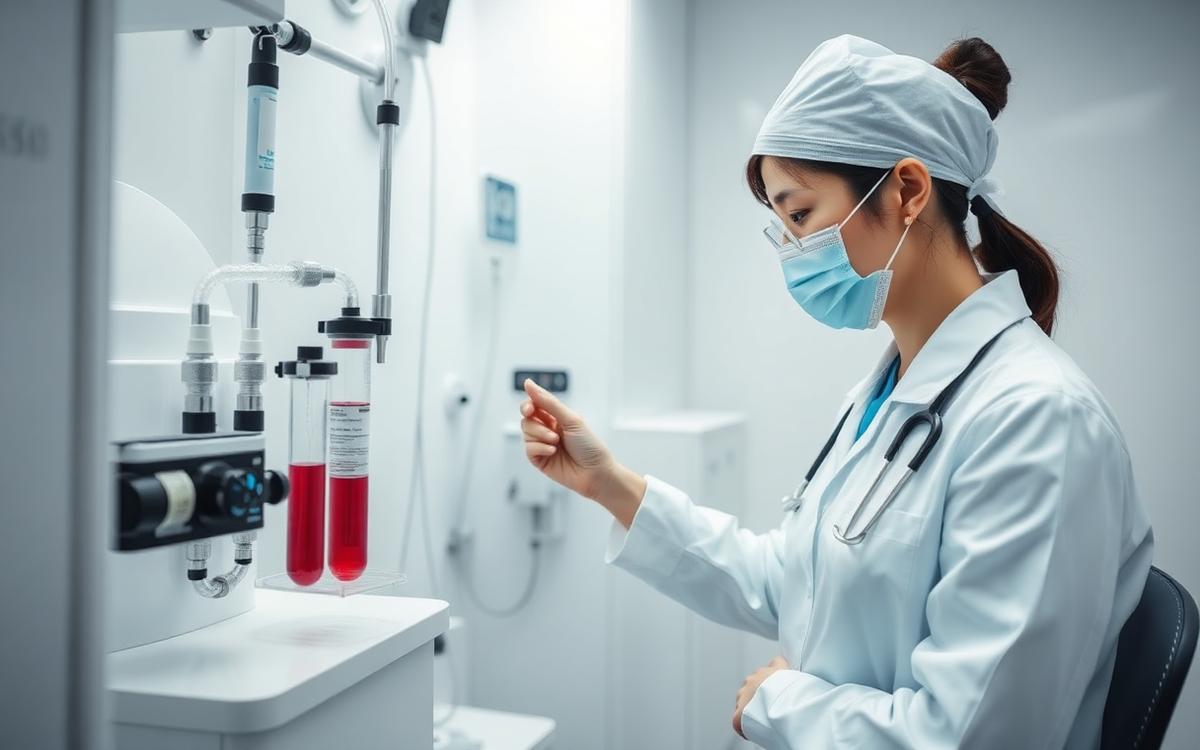
From the draw, through the light and oxygen circuit, back into the body

Quick answer

HemaPure draws a limited volume of venous blood through a single-use circuit. The blood passes a quartz tube where ultraviolet light is applied and medical oxygen is added, then returns to the same person. The premise is that light and oxygen stimulate white blood cell activity and rebalance inflammation. The whole loop is closed and takes about one to two hours.

Key facts

Principle
UV irradiation plus oxygenation in a closed circuit
Blood used
The client's own blood, fully returned
Consumables
Single-use tubing set
Optional add-on
Plasma lipid filtration
Monitoring
Nurse or doctor present throughout

A nurse first opens a line in the arm much like an IV. Blood is drawn a little at a time by a low-speed pump rather than all at once, so only a small volume sits outside the body at any moment. That is why most clients keep scrolling their phone or watching a series throughout.

The core of the system is a quartz tube that lets UV pass through. Light at a defined wavelength hits the blood cells directly. Older research from the pre-antibiotic era proposed that this primes the immune response; Korean clinics have adapted the idea into a wellness context, combined with oxygenation.

Some programmes add a filtration step that removes lipids and certain inflammatory components from plasma — a different technique from UBI and usually more expensive. Ask the clinic explicitly whether the package is irradiation only or includes filtration, because the expected outcome and precautions differ.

Safety rests on three things: the tubing and needles must be single-use, a doctor or nurse must monitor throughout, and there must be a pre-screen confirming no contraindications such as bleeding disorders or severe anaemia. A good clinic explains all three without being asked.

Frequently asked questions

  • Is all the blood returned?

    Yes. The circuit is closed and the client's own blood is returned in full, except for any sample agreed in advance for laboratory testing.

  • Does it hurt?

    It feels like a normal blood draw or IV — a pinch when the needle goes in. After that most people feel nothing beyond a cool sensation in the arm.

  • Is UV light harmful to blood?

    The dose is machine-controlled and exposure is brief, unlike prolonged UV on the skin. Still, anyone with photosensitivity or taking photosensitising drugs should tell the doctor beforehand.

  • Do I need to fast beforehand?

    Usually no fasting is needed and drinking water helps the vein access. The exception is when a fasting blood panel is scheduled, which the clinic will tell you in advance.

  • How long does it take?

    About one to two hours per session, plus a pre-assessment and roughly 15–30 minutes of observation afterwards.

  • Irradiation versus filtration — what differs?

    Irradiation aims to stimulate blood activity, while filtration removes lipids and certain substances from plasma. Filtration costs more and carries more precautions, so clarify before booking.

Medical cautions

5 points • reviewed 2026-09-03

Expand
  • This article is educational information only — not a diagnosis, prescription, or personal medical advice.
  • Outcomes vary by person, depending on age, underlying conditions, current medication, and the treating doctor's technique.
  • Consult a licensed physician and verify the clinic's licence before deciding on any treatment.
  • Some treatments (certain stem cell therapies in particular) are regulated differently by country — check Thai and Korean rules before travelling.
  • Prices, packages, and service details can change — confirm directly with the provider before paying.

Reviewed and last updated: 2026-09-03

References and sources

4 sources • every claim is traceable

Expand
  1. 1. Korea Ministry of Food and Drug Safety (MFDS)

    https://www.mfds.go.kr/eng/index.do

  2. 2. Korea Ministry of Health and Welfare (MOHW)

    https://www.mohw.go.kr/eng/

  3. 3. PubMed medical research database (NIH)

    https://pubmed.ncbi.nlm.nih.gov/

  4. 4. Medical Korea — official info for international patients (KHIDI)

    https://www.medicalkorea.or.kr/

Browse the full reference library →

Share this page

Last updated: 2026-09-03 · This content is for information only and is not medical advice. Consult a qualified doctor before making treatment decisions.

Back to categories
See all in this category